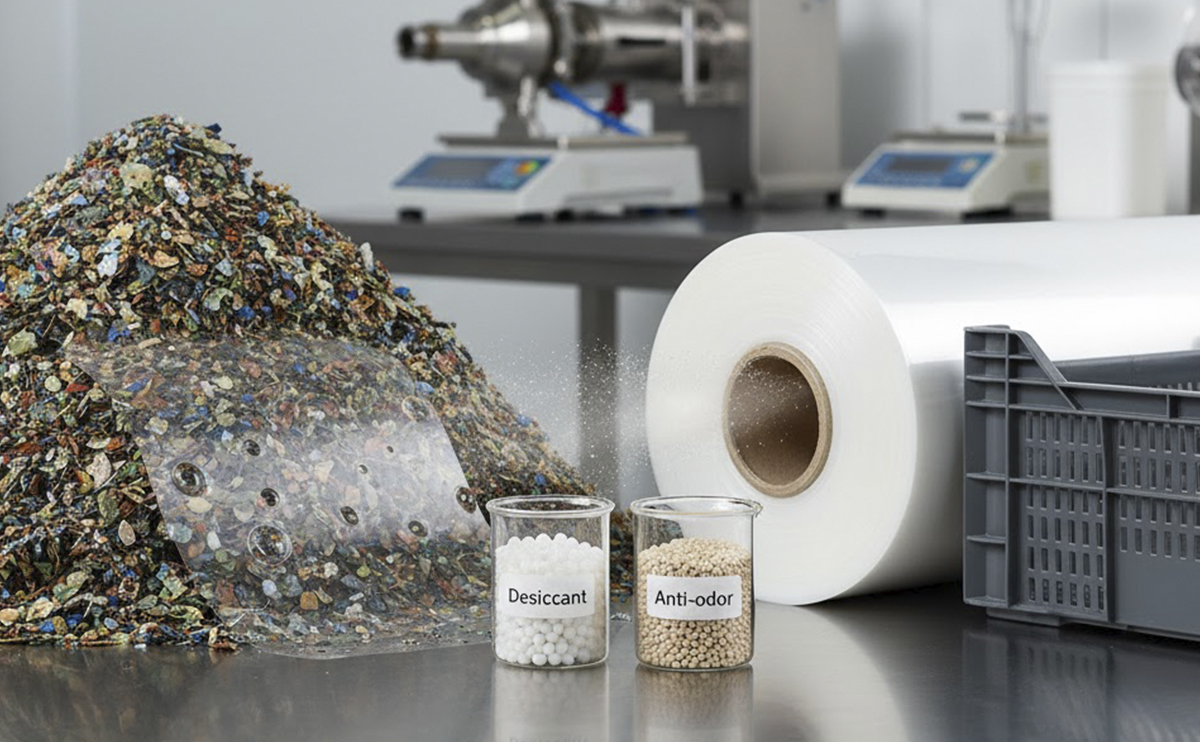
How Desiccant Solves the Moisture Problem
Desiccant masterbatch is a simple yet brilliant solution. You no longer need to pre-dry recycled raw materials. You simply add 1–5% LDR directly into wet rPE or rPP.
Inside the extruder, at high temperatures, the active components (such as calcium oxide) chemically bind water molecules. They do not merely “absorb” moisture — they react with it irreversibly, converting H₂O into a stable, powder-like compound. Steam formation is completely eliminated.
Result: You fully remove the drying stage, saving hours of production time and thousands of GEL on electricity. You get a perfect surface without pores or fish-eyes — even when processing the wettest, cheapest recycled feedstock.
How Anti-odor Eliminates Unpleasant Odors
Anti-odor masterbatch is not a fragrance. It does not mask the smell — it neutralizes it chemically.
Its action is based on molecular sieves (zeolites) or other porous structures that act like a sponge. During extrusion, they capture and trap volatile organic compounds responsible for unpleasant odor. The odor is physically removed from the melt and does not migrate into the final product.
Result: You obtain a finished product with a neutral smell, which allows the use of rPE or rPP in a much wider range of applications without customer complaints.
Your B2B Strategy: Turning Waste into Profit
Using Desiccant and Anti-odor together is a powerful technological strategy. It enables you to purchase the cheapest, most problematic raw materials (washed, wet, contaminated regrind) and convert them into high-quality, competitive products.
At Caucasus Polymer Group, we provide full technical support for working with recyclate. We analyze your secondary raw materials, help determine the correct LDR for both additives, and supply test samples so you can verify the results yourself.
Ready to reduce production costs using recycled materials without defects? Contact us for a formulation audit.