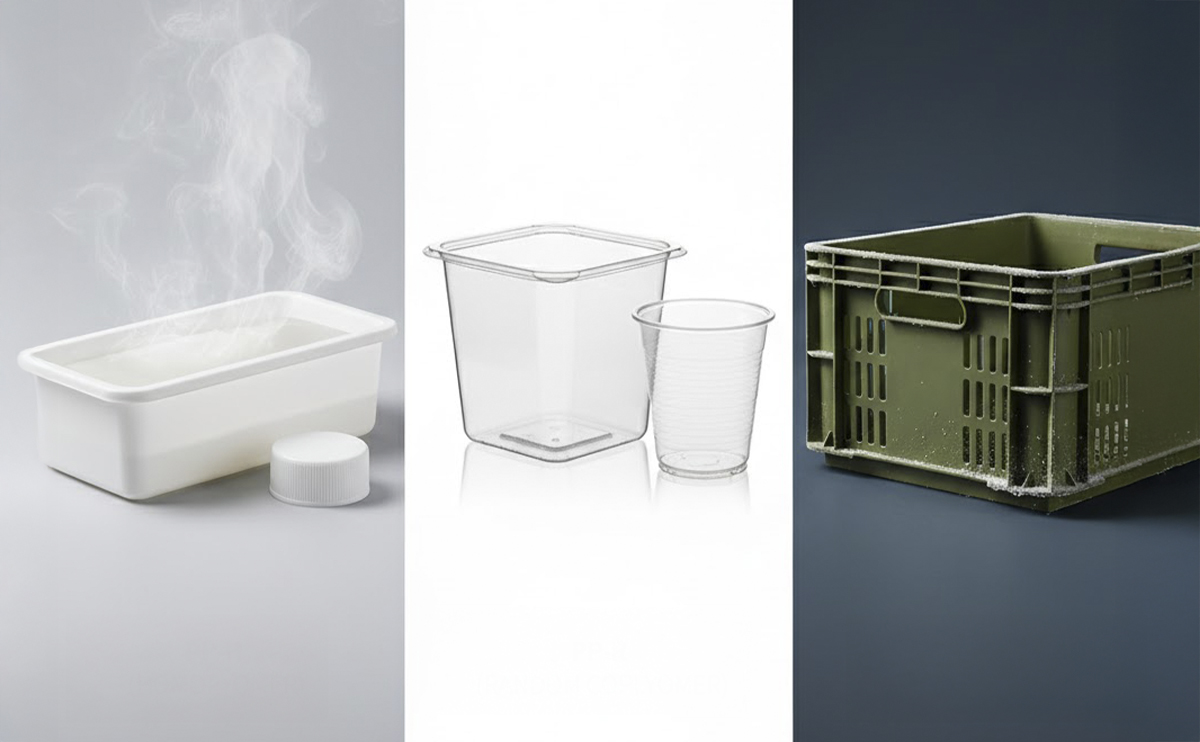
PP Homo vs. PP Random vs. PP Block: How to Choose the Right Polypropylene for Injection Molding and Extrusion
For B2B manufacturers, choosing the correct raw material determines 90% of success. In the category of polypropylene (PP), there are three major “families”: Homo-polymer (PP-H), Block-copolymer (PP-B), and Random-copolymer (PP-R). Although the granules look similar, their physical and mechanical properties differ dramatically.
Selecting the wrong PP grade guarantees defects. A freezer container made from PP-H will crack, while a sterilizable PP-R medical component may become hazy. In this guide, as technologists at Caucasus Polymer Group, we break down the differences in simple terms.
PP-H (Homo-polymer): Rigidity and Heat Resistance
PP-H is the “purest” form of polypropylene, consisting only of propylene molecules.
- Key property: Very high stiffness and thermal resistance. It withstands boiling and steam sterilization without deformation.
- Weakness: Brittle at low temperatures — becomes fragile around 0°C.
- Applications: Medical disposables (syringes), caps, household items, hot-water pipes, BOPP film extrusion.
PP-B (Block Copolymer): Impact Strength and Cold Resistance
PP-B is commonly known as “impact-resistant polypropylene,” containing ethylene blocks inside the structure.
- Key property: Excellent impact strength and cold resistance. Remains tough and flexible down to -20°C.
- Weakness: Not transparent; lower stiffness compared to PP-H.
- Applications: Crates, pallets, battery housings, automotive bumpers, freezer containers, buckets.
PP-R (Random Copolymer): Transparency and Flexibility
PP-R contains ethylene molecules randomly distributed within the propylene chain.
- Key property: High clarity and gloss. Softer and more elastic than PP-H or PP-B.
- Weakness: Lower melting temperature and stiffness than PP-H.
- Applications: Thin-wall packaging (IML), transparent cups and food containers, thermoforming sheets.
Our Solutions: Polypropylene Grades and Additives